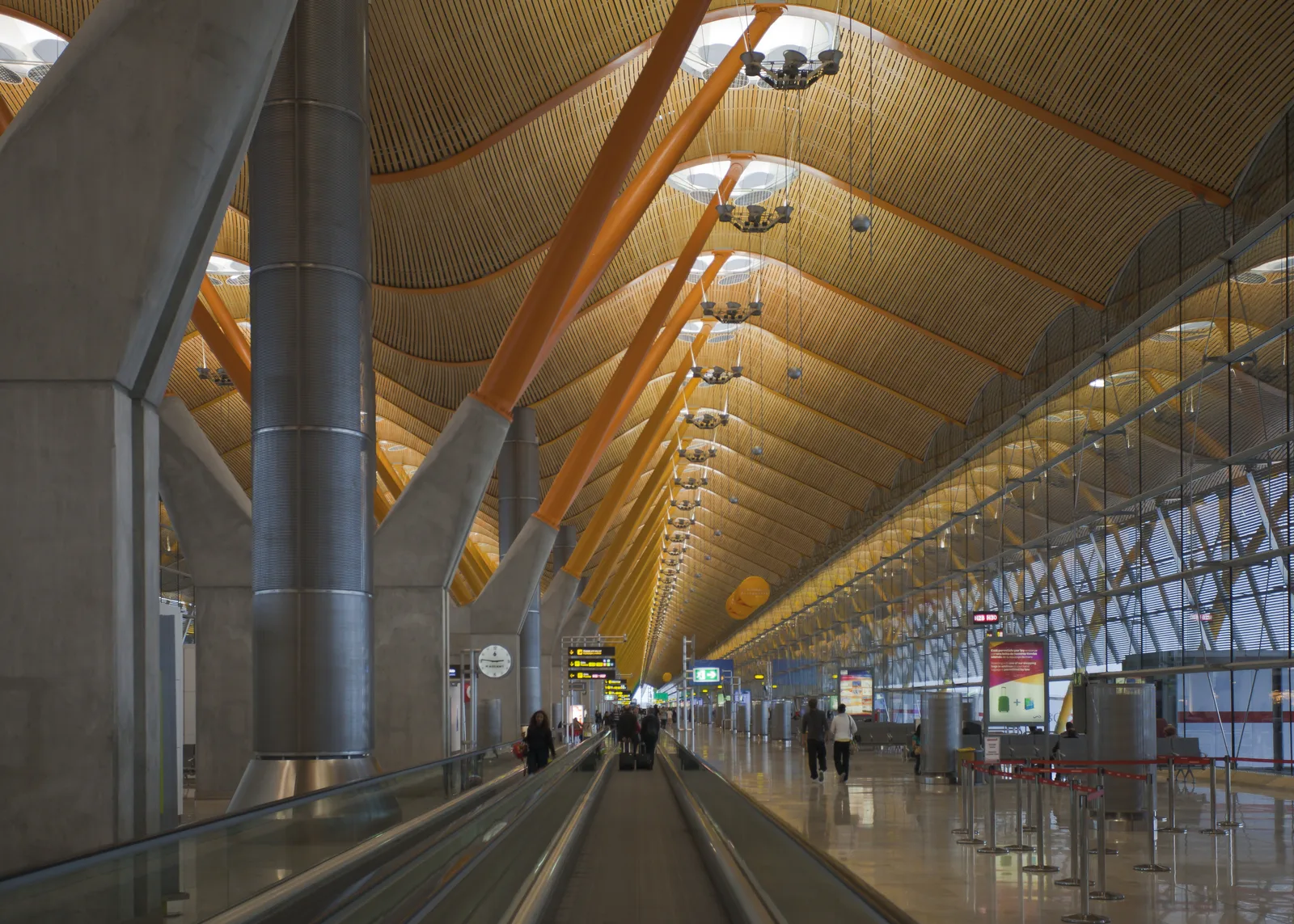
Layover at Madrid Airport
Madrid Barajas is one of Europe's most active connecting hubs, and a substantial share of the passengers passing through it each year are not arriving in Madrid as their final destination — they are using Madrid Airport (MAD) as the bridge between continents. Iberia's hub model funnels enormous traffic between Latin America, Europe, North America, and a growing range of Asian and African destinations. For most of these travelers, "layover" is not a one-hour pass-through but a substantial gap of three, six, or twelve hours between flights — long enough to demand a real plan, short enough that mistakes become costly.
This guide is built around the practical question every connecting passenger asks: what should I actually do with this time? The answer depends on how long the layover is, what your visa status allows, where your bags are, and how comfortable you are taking the metro into central Madrid and back. The sections below walk through each layover length, the procedures involved, and the realistic options for using the time well rather than enduring it in a gate area.
Madrid is a particularly good airport to be stuck in. The terminal architecture, especially in T4 and T4S, is genuinely pleasant. Food is significantly better than at most European hubs, with Spanish jamón, tapas, and wines available throughout. The metro into central Madrid takes about twenty-five minutes from the airport, making short city visits realistic for layovers of four hours or longer. And if you are too tired to do anything but sleep, the airport accommodates that too, with hotels at every price range and a series of quieter zones for in-terminal rest.
Understanding Layovers at Madrid Airport
A layover is the gap between two flights on a single journey. At Madrid, layovers fall into several functional categories that determine what you can sensibly do with the time. The most consequential dividing lines are physical — same terminal, different terminal, T4-to-T4S, and T1/T2/T3 to T4 — and procedural — Schengen-to-Schengen, Schengen-to-non-Schengen, and full international transit. Knowing which categories your specific layover involves shapes everything else.
Same-terminal Schengen-to-Schengen connections are the simplest. You stay airside the entire time, walk between gates within a single building, and can be at your next gate within twenty minutes if needed. Same-terminal international-to-international connections require slightly more attention, particularly at T4S where the satellite terminal has its own gate clusters and longer walking distances, but the procedure remains airside throughout.
Cross-terminal connections are the more complex case. T1, T2, and T3 are physically connected by walkways and underground passages, so connecting between them requires only walking time and possibly a security re-check depending on the specific gates involved. The challenging connections are between the T1/T2/T3 cluster and the T4/T4S cluster, which are separated by several kilometers and require either the inter-terminal shuttle bus or a longer detour. For these connections, the published minimum is 90 minutes airside, and 120 minutes is more realistic during peak hours.
Schengen-to-non-Schengen and reverse connections are also worth understanding. If you are arriving on a Schengen flight (from Paris, Berlin, Rome, etc.) and connecting to a non-Schengen flight (London, New York, Buenos Aires), you will need to pass through Spanish passport control before reaching the international departure area. The same is true in reverse: arriving from a non-Schengen origin and connecting to a Schengen destination requires immigration on arrival, then proceeding airside to your next gate. Knowing which procedure applies to your specific connection helps you allocate time correctly.
Layover by the clock: how much time you actually have
Madrid rewards a city visit, but only after you subtract the overhead. Getting from your seat to a Madrid street takes roughly 90 minutes once you add disembarking, immigration, the walk out to the public area and the 25–35 minute ride in on the Metro or Cercanías. Getting back and through security costs about the same again. Budget three hours of overhead, then see what is left of your layover.
| Layover length | Time actually in the city | Verdict |
|---|---|---|
| Under 3 hours | None | Stay airside — the round trip alone swallows the gap |
| 4 hours | About 1 hour | Tight; only if you know exactly where you are going |
| 5 hours | About 2 hours | One neighbourhood and a coffee, nothing more |
| 6 hours | About 3 hours | Comfortable: one area, one sight, a proper meal |
| 7 hours | About 4 hours | Two sights, or lunch without watching the clock |
| 8 hours | About 5 hours | Half a day — the sweet spot for a first look at Madrid |
| 10 hours or more | About 7 hours | A full, unhurried day with museums included |
| Overnight | — | Airport hotel or a planned night airside; see the sections below |
Two things move these numbers. If you are not an EU, EEA or Swiss citizen, arrival now includes biometric registration at the border under the Entry/Exit System, and a first registration takes noticeably longer than later crossings — read our Madrid airport passport control guide before you rely on the lower end of any estimate. And if you land at T4 or T4S but depart from T1, add the inter-terminal shuttle to both halves of the journey.
Short Layovers (Under 3 Hours) — Stay Inside the Terminal
For layovers of three hours or less, leaving the airport is rarely worth attempting. By the time you have disembarked, walked to the public arrivals area, taken the metro into central Madrid, found a destination, spent some time there, returned to the metro, gone back to the airport, cleared security, and walked to your gate, the three hours is gone. Even a four-hour layover is tight for a city visit; under three hours, plan to stay inside.
The good news is that staying inside Madrid Airport is not a punishment. The terminals are well-equipped with food, shops, lounges, and quiet areas. The Iberia premium lounges in T4 and T4S are widely regarded as among Europe's best for travelers with appropriate access. Pay-per-use lounges (Sala VIP Cibeles, Plaza Premium) and Priority Pass-accessible lounges offer comfortable alternatives for travelers without status access. And the gate areas themselves, particularly in T4 and T4S, have quiet seating, charging points, and good views of the apron — sometimes more comfortable than crowded city cafés.
For short layovers, the priorities are simple: identify your next gate, plan your walking route to it, have a meal or coffee, get some work done if needed, and arrive at the gate fifteen to twenty minutes before boarding. If your layover involves a terminal change, factor that into your timing — the inter-terminal shuttle takes about ten to fifteen minutes airside and longer landside, so a two-hour layover with a terminal change leaves very little buffer.
One useful practice for short layovers is to confirm your departure gate immediately upon arrival rather than at the last minute. The gate displays publish information thirty to sixty minutes before boarding, so checking the screens early allows you to walk toward the right area while you still have time. This is particularly important at MAD because some gates require fifteen to twenty minutes of walking from the central concourse. Visit our terminals guide for a detailed view of layouts.
Medium Layovers (4-8 Hours) — Decision Time
Layovers of four to eight hours are the interesting case. They are long enough that staying in the terminal feels wasteful, but short enough that any city visit must be carefully planned. The right decision depends on several variables: your visa status, your terminal of arrival and departure, the time of day, your energy level, and what you actually want to do with the time.
If you are a citizen of a country with visa-free entry into the Schengen Area (most of the EU, the UK, US, Canada, Australia, Japan, and many others), leaving the airport is relatively straightforward. You pass through Spanish immigration on arrival, exit the terminal, take the metro or train to central Madrid, do whatever you came to do, and reverse the process to return for your departure. Plan for at least 90 minutes from gate exit to feet-on-Madrid-streets, and 90 minutes back, leaving four to six hours of layover for actual city time.
If you require a Schengen visa and do not have one, you cannot leave the airport. You remain in the international transit area until your departure. This is worth confirming before traveling, particularly for travelers from countries that don't normally need Schengen visas but might in specific circumstances. The Spanish embassy or consulate can confirm requirements; most airlines also publish guidance.
For a medium layover with the option to leave, the most efficient itineraries focus on a single Madrid neighborhood rather than trying to see multiple sights. The classic short visits include Plaza Mayor and Sol (the historic center), Retiro Park (green space, easy to access), the Prado area (museum-focused), or Gran Vía (shopping and people-watching). Pick one based on your interest and stay there rather than racing across the city. For deeper guidance on neighborhoods, see our Madrid travel guide.
Long Layovers (8-24 Hours) — Time to Explore
Layovers of eight to twenty-four hours are real opportunities. With this much time, you can comfortably leave the airport, see meaningful parts of Madrid, eat properly, and return without rushing. Many travelers find these long layovers among the more enjoyable parts of their trip, particularly if they arrive in the morning and have a full day before an evening departure.
The standard long-layover plan looks something like this: clear immigration and customs upon arrival (90 minutes buffer), take the metro or Cercanías to central Madrid (25-35 minutes), have a substantial breakfast or lunch in a local café, visit one or two sights on a focused itinerary, take a longer break for tapas or coffee in a non-touristy neighborhood, return to the airport with two hours buffer for security, and use the gate-side time for a final meal or shopping.
For travelers with eight to twelve hours, ambitious itineraries are possible. The Prado Museum can absorb three hours; the Retiro is a perfect mid-day break; tapas in La Latina or Lavapiés provides authentic Spanish food. For travelers with twelve to twenty-four hours, the calculus shifts toward whether to book a hotel for sleep or push through. The deciding factors are your normal sleep schedule, the comfort of your incoming flight, and what your departing flight looks like.
Booking a hotel near the airport for a few hours of real sleep can transform the rest of your journey. Properties at the airport have day-rate options for travelers needing rest between flights, and several hotels in the Barajas neighborhood offer flexible check-in policies for layover travelers. See our hotels near MAD guide for properties that work well in this scenario.
Overnight Layovers — Sleeping at MAD or in a Hotel
Overnight layovers — typically defined as connections that span six or more hours during what would normally be sleeping time — present a particular set of choices. The two main options are staying in the airport overnight or booking a hotel and returning for the morning departure. Both have advantages, and the right choice depends on your tolerance for airport sleeping, the hotel's price, and how exhausted you arrive.
Sleeping in Madrid Airport is feasible but not particularly comfortable. The terminals are open all night, security is constant, and the airport is generally safe and quiet between 1 AM and 5 AM. T4 has quieter zones away from the main concourse where it's possible to find a stretch of seating to lie across. Some travelers bring blow-up neck pillows, eye masks, and earplugs and report acceptable rest. Others find the lighting, announcements, and ambient activity prevent real sleep.
Hotels at and near the airport are the better choice for most travelers with seven or more hours overnight. The on-airport Meliá Madrid Aeropuerto is the most convenient — a short walk from T4. The Barajas neighborhood has multiple hotels (Hilton, AC Marriott, NH, Holiday Inn, etc.) with airport shuttles, typically running every 15-30 minutes. Most of these properties accept arrivals at any hour and offer late check-out options or partial-day rates for layover guests. Booking just a few hours of real sleep in a real bed often makes the difference between a continued journey that feels manageable and one that feels brutal.
The cost calculation matters too. Airport-area hotels typically run €80-150 per night for solid mid-range properties. Day-use rates can be lower. Compared to enduring eight hours of poor sleep at the airport, the cost is often worth it for travelers who can absorb the expense. For business travelers and those who simply value rest, the hotel option is generally the better choice.
Visa and Schengen Considerations Before Leaving the Airport
The decision about whether you can leave the airport during your layover is governed by Spanish and Schengen entry rules. The Schengen Area is a passport-free zone covering most EU countries plus a few non-EU members (Switzerland, Norway, Iceland). Spain is a Schengen member, so entering Spain means entering the Schengen Area more broadly.
Citizens of countries with visa-free Schengen access — including the US, Canada, UK, Australia, Japan, South Korea, and many others — can typically leave the airport without prior arrangement, simply passing through Spanish passport control on arrival and showing their passport. The visa-free stay limit is 90 days within any 180-day period; a layover use does not significantly affect this allowance for most travelers, but it does count against the limit.
Citizens of countries requiring Schengen visas need an active visa to leave the airport. If you have a Schengen visa for any purpose (tourism, business, etc.), it is generally usable for a layover too, provided it is valid for the date of your transit. Single-entry visas that you have already used for a previous Schengen visit may not allow re-entry; multi-entry visas typically do. Always confirm with the Spanish consulate or your airline if you are unsure.
Travelers in international transit who do not leave the immigration area technically do not enter Spain, and visa requirements for transit-only passengers are different. Most countries' nationals can transit through Madrid airside without a visa, but a small number require an Airport Transit Visa even for transit-only stays. The Spanish consulate maintains a current list of these countries.
One important practical note: if you have any doubt about your right to enter, do not leave the airport. Being refused entry at Spanish immigration is a serious complication that can affect your onward travel and create lasting issues. When in doubt, stay airside for the layover and confirm requirements before your next trip.
What to See in Madrid in 4-6 Hours — A Quick City Tour?
For a layover of four to six hours, the realistic city visit is about two to three hours on the ground, plus the airport-to-city and city-to-airport journeys. Two to three hours is enough for one major sight or one substantial neighborhood walk, plus a meal. It is not enough for multiple museums or extensive sightseeing.
The most efficient short itinerary for first-time visitors is the historic center route. From the airport, take Metro Line 8 to Nuevos Ministerios, change to Line 10 toward Puerta del Sur, and exit at Sol or Plaza España. From either station, you are within walking distance of Plaza Mayor (Spain's iconic main square), the Royal Palace, the Almudena Cathedral, and the Madrid de los Austrias historic quarter. A focused two-hour walk through this area gives you the visual essence of Madrid without rushing.
For travelers more interested in green space than history, the Retiro Park route is excellent. Take the metro to Atocha (via Line 1) and walk into Retiro from its southwestern entrance near the Prado. The park itself is large, beautiful, and free, with a boating lake, gardens, and the famous Crystal Palace. This route also passes the Prado Museum entrance, so travelers wanting a quick museum stop can integrate it.
For travelers focused on food, the La Latina or Malasaña neighborhood routes work well. La Latina (south of Plaza Mayor) is the heart of traditional tapas culture, with Cava Baja street offering classic bars in a small area. Malasaña, north of Gran Vía, is the contemporary cool neighborhood with cafés, vintage shops, and contemporary Spanish cooking. Either area can be reached in 30-40 minutes from the airport.
Recommended Layover Routes from MAD
Beyond the standard tourist routes, several layover-friendly itineraries work well for the Madrid airport context. The first is the "Atocha plus Retiro" route — take the Cercanías C-1 train from Terminal 4 directly to Atocha (about 25 minutes), explore the Atocha Glasshouse (a tropical garden inside the train station), then walk into Retiro through the southern entrance. This route maximizes time efficiency by using the fastest train option.
The second is the "Recoletos and Cibeles" route, which works well for travelers with mid-length layovers. Take Metro Line 8 to Nuevos Ministerios, change to Line 10 toward Puerta del Sur, exit at Tribunal or Alonso Martínez. Walk down Castellana to Cibeles fountain, then up Recoletos boulevard to Plaza Colón. This north-central route showcases Madrid's grand boulevards and is particularly pleasant in late afternoon light.
The third is the "Lavapiés food tour" route — Madrid's most multicultural neighborhood, full of authentic ethnic restaurants and tapas bars. Take Line 8 to Nuevos Ministerios, change to Line 1 toward Valdecarros, exit at Lavapiés. The neighborhood is small and walkable, with excellent food at all price points and a relaxed atmosphere quite different from tourist Madrid.
For travelers preferring to skip central Madrid entirely, the area immediately around Madrid Airport offers some less-explored options. The Barajas village (the original town, now part of greater Madrid) has traditional Spanish cafés and a historic church. Several parks near the airport (Parque Juan Carlos I, Parque del Capricho) offer green space without the metro journey. These are useful for travelers with limited mobility or those wanting a calmer break.
Eating Well During a Layover — Spanish Food at the Airport vs City
One of the genuine advantages of a Madrid layover is the food. Spanish cuisine is among the best in Europe, and even at the airport you can eat substantially better than at most international hubs. Several jamón specialty bars in Terminal 4 offer Iberian acorn-fed jamón that is hard to find outside Spain, paired with manchego cheese and Spanish wines. This experience alone is worth lingering for if you have the time.
Beyond jamón, Madrid Airport has decent representation of Spanish chains and concepts. 100 Montaditos offers small open sandwiches at low prices. Lizarrán serves pintxos, the Basque-style canapés. Various tapas bars provide quick small plates of Spanish staples. Coffee culture is strong throughout, with proper espresso and Spanish café con leche available at multiple locations. The food in T4 is generally better than in T1 or T2, though all terminals have at least one solid Spanish option.
For travelers who choose to leave the airport, central Madrid offers an enormous improvement. La Latina, Lavapiés, Malasaña, and Chueca all have excellent eating options at every price point. The "menu del día" lunch tradition (a multi-course set lunch at €12-18) is the best value in Madrid food culture and runs Monday through Friday in most local restaurants. Tapas crawls through several bars are the classic Madrid evening, possible during longer layovers.
If you have a food-focused layover, prioritize a meal in the city over a meal at the airport. The quality difference is significant, and Madrid's lunch culture is particularly accessible — most restaurants serve from 1:30 to 4:00 PM, fitting many international flight schedules. Save airport food for the time after security when you are committed to the gate.
Shopping at Madrid Airport
Madrid Airport's retail offering is substantial, though most travelers will find more interesting purchases in central Madrid if they have time. The airport's strongest categories are duty-free spirits, perfume, cosmetics, and Spanish specialty foods. Spanish wines, olive oils, jamón (vacuum-packed for travel), and turrón make particularly good purchases at MAD duty-free, often at competitive prices.
Luxury fashion has a substantial presence in T4 and T4S, with Hermès, Loewe, Bvlgari, Gucci, and others represented. Mid-market Spanish brands like Mango, Massimo Dutti, Camper (shoes), and Adolfo Domínguez are widely available. Bookstores carry Spanish literature in translation alongside international titles. Electronics retailers handle phones, accessories, and travel adapters.
For travelers leaving the airport, central Madrid shopping is concentrated in several areas. Gran Vía has the major international fashion brands. Calle Serrano (in Salamanca neighborhood) has high-end designer shops. Mercado de San Miguel near Plaza Mayor is the famous Spanish food market — touristy but excellent for picking up Spanish food gifts. Malasaña has independent boutiques with Spanish design at reasonable prices.
Travelers who are price-sensitive should be aware that airport prices for non-duty-free items are typically marked up 20-40% over city center retail. The duty-free benefit applies only to specific categories (alcohol, tobacco, perfume, certain cosmetics), and only for non-EU departures.
Lounges and Rest Areas at MAD
For the full inventory of what is inside the terminals — the art collection, every lounge by name, the free rest zones by gate, play areas and the chapels — see things to do at Madrid Airport.
For layover travelers with appropriate access, lounges transform the experience. The Iberia premium lounges in T4 and T4S are particularly good — extensive food and beverage selections, comfortable seating, quiet zones, showers, and good views of the apron. Iberia operates the Sala VIP Velázquez (the largest Iberia lounge in their network) and Sala VIP Dalí, both serving Iberia premium passengers, Oneworld status holders, and guests.
Pay-per-use lounges accept walk-up customers and lounge program memberships (Priority Pass, LoungeKey, Diners Club). Sala VIP Cibeles in T1 serves international travelers; Plaza Premium Lounge has locations in multiple terminals. Walk-up rates are typically €30-50 per visit. For travelers with multiple layovers per year, Priority Pass memberships can become cost-effective quickly.
Beyond the official lounges, Madrid Airport has informal quiet areas worth knowing about. The mezzanine level of T4 (above the main concourse) has comfortable seating with fewer travelers passing through. T4S has quiet zones at the far end of the satellite, away from the main gate clusters. These are useful for travelers who want rest without paying for lounge access.
Charging stations are plentiful throughout the airport, with most newer seating areas including USB and standard outlets. Free WiFi works well throughout, with no time limits and reasonable speeds. For business travelers, finding a quiet workspace is realistic in T4, with several airline-area cafés offering tables suitable for laptop work.
Sleeping at the Airport — A Practical Guide
For travelers committed to sleeping at the airport rather than booking a hotel, several practices improve the experience. The first is choosing the right zone. T4 generally has the best sleeping spots — quieter, better seating, and fewer all-night announcements than T1. Within T4, the gate areas at the far ends of the concourse are quieter than the central area near the main shopping. Avoid the immediate vicinity of duty-free shops, which may make announcements throughout the night.
Bring the right gear. A neck pillow makes seated sleeping more practical. An eye mask blocks the constant light. Earplugs or noise-canceling headphones help with announcements and ambient noise. A light blanket or sweater handles the cool airport temperatures. Phone charger and power bank ensure you can stay connected. A small towel or change of clothes can be useful for freshening up before your morning flight.
The security situation at Madrid Airport overnight is generally good. Police patrol the terminals, and the airport is well-lit and busy enough that incidents are rare. Keep valuables on your person rather than in checked baggage, and be aware of your belongings — sleep with bags as anchors or use simple straps to attach them to your seating.
Bathrooms are open all night. Showers are not generally available in public areas, though some lounges offer them and Madrid Airport's "Mad Pause" service provides temporary rest pods (sleep capsules) that include shower access — a paid option for travelers wanting a bit more comfort without committing to a full hotel.
Hotels Near Madrid Airport for Longer Layovers
For overnight layovers or extended layovers where rest matters, hotels near Madrid Airport offer significantly better experiences than terminal sleeping. The closest option is the Meliá Madrid Aeropuerto, located adjacent to T4 and accessible by short walk. This is the only hotel directly within the airport complex, offering immediate access to T4 without shuttle dependency.
The Barajas neighborhood (a 5-15 minute drive from the terminals) has a substantial cluster of hotels. Hilton Madrid Airport is large and business-focused. AC Hotel by Marriott Aeropuerto Madrid offers a more design-conscious option. NH Madrid Barajas and several Holiday Inn properties round out the mid-range. Most of these run free shuttles to and from the airport every 15-30 minutes, with the journey taking about 10 minutes.
For travelers wanting a more central option that still allows easy airport access, hotels along Metro Line 8 (Nuevos Ministerios area, Mar de Cristal, Colombia) offer compromise. They are not airport hotels but connect to MAD in 15-25 minutes by direct metro. This is useful if you want some city experience overnight while keeping the morning airport journey simple.
Many properties offer day-use rates or short-stay packages specifically designed for layover travelers. These typically allow 6-8 hours of access at substantially lower rates than full nightly stays. Calling ahead or using day-use booking platforms often unlocks these rates that aren't published on standard booking sites.
Luggage Storage at Madrid Airport
For travelers wanting to leave the airport during a layover but with carry-on or other bags they don't want to schlep through Madrid, luggage storage is available at MAD through the AENA Storage service. Storage points are located in T1 and T4, with prices ranging from €5-15 per bag depending on size and storage duration. Booking online in advance often secures lower rates than walk-up pricing.
The official storage operates roughly 24 hours, though specific hours can vary. Bags must pass a security screening before being accepted, and the service does not handle dangerous items, fragile valuables that aren't packed properly, or food items that might spoil. For most travel bags, the service is straightforward and reliable.
For travelers with checked baggage already in transit, the bags are typically transferred automatically between connecting flights — they arrive at your final destination. You do not need to claim and re-check checked bags during a typical layover. The exceptions are if your itinerary is on separate tickets (different bookings rather than one connected booking), or if you're explicitly told at check-in that the bags are tagged only to Madrid. In these cases, you collect bags upon arrival, exit baggage claim, and re-check for the next flight.
Carry-on bags can be brought into central Madrid, of course, but the metro and Cercanías systems are not particularly luggage-friendly during peak hours. The metro lacks elevators in older stations and stairs can be a nuisance with large bags. Storing carry-ons at the airport before a city visit often makes the trip more pleasant.
Getting Back to the Airport in Time for Your Connection
The most stressful part of a layover with city visit is the return journey. The temptation is to push the city time as long as possible; the reality is that returning two hours before your connection departure (rather than the 45-60 minutes you might use at home) is the right buffer for a layover situation. You need time for the journey back, security, possible immigration (for non-Schengen connecting flights), and walking to the gate.
The metro from central Madrid to the airport takes 25-40 minutes depending on transfers and station. Cercanías from Atocha to T4 is 25 minutes plus station-to-platform walking time. The Express Bus from Atocha to the airport is 35-45 minutes depending on traffic. Plan for the longer end of these ranges.
Once you arrive at the airport, allow 60-90 minutes airside for the typical layover return process. This includes security re-screening (always required for connecting flights you're starting from), possible immigration if you're connecting Schengen-to-non-Schengen, walking time, and gate-area arrival. For T4-to-T4S connections specifically, the people-mover adds another 5-10 minutes.
If your departing flight is from a different terminal than your arriving flight, account for the inter-terminal shuttle time and any required additional security re-screening. Cross-terminal layovers (T1/T2/T3 to T4 or vice versa) require 90+ minutes airside reliably. Very tight cross-terminal connections leave no buffer for security delays or unexpected complications.
Common Layover Mistakes Travelers Make at MAD
Several mistakes recur across layover experiences at Madrid. The most common is underestimating the journey time between the airport and central Madrid. Travelers often estimate 20-30 minutes based on Google Maps and find the actual experience takes 40-60 minutes including waiting, transfers, and walking. Always plan for the longer end and treat the shorter time as an unexpected gift if it works out.
The second is leaving the airport without confirming visa status. Travelers from countries that may need Schengen visas sometimes assume their citizenship allows free entry and find themselves at immigration with documents that don't permit entry. Confirming this before traveling — through the Spanish consulate or your airline — prevents serious problems.
The third is forgetting that connecting flights typically require security re-screening even if both flights are with the same airline. Madrid does not have a "transit-only" sterile area as some Asian hubs do; you need to clear security for the next flight. Plan for this in your buffer time.
The fourth is underestimating walking distances within the airport. Some gates in T4S can be 15-20 minutes' walk from the people-mover entrance, and some gates in T1 are similarly distant from security. Allow walking time to the gate as a separate buffer, particularly for layovers under 2 hours.
The fifth is over-ambitious city itineraries. Travelers with a 5-hour layover sometimes plan to see the Prado, Plaza Mayor, Royal Palace, and have lunch — and end up doing none of them properly because the rushing leaves no time to enjoy any single experience. Pick one focus and stay with it. The depth of experience matters more than the breadth.
The sixth is assuming the metro and trains run on the same schedule as your departure airport. Madrid's metro closes around 1:30 AM and reopens at 6:00 AM. Cercanías has similar overnight gaps. The Express Airport Bus runs 24 hours, but other public transit options are limited during the overnight window. For early-morning departure from MAD after an overnight layover, plan for taxi or pre-arranged transfer if your hotel doesn't have shuttle service that fits your schedule.
Have a layover question? Reach out.
You May Also Like
- Madrid Airport Terminals
- Madrid Airport Guide
- Hotels near Madrid Airport (MAD)
- Madrid Travel Guide
Plan your trip — airport routes
 AranjuezCity
 ÁvilaCity
 CuencaCity
 El Escorial (San Lorenzo)City
 SegoviaCity
 ChuecaNeighborhood
 Gran VíaNeighborhood
 La LatinaNeighborhood
 LavapiésNeighborhood
 MalasañaNeighborhood
 MoncloaNeighborhood
 Puerta del Sol (City Centre)Neighborhood
 Salamanca districtNeighborhood
 ValdebebasNeighborhood
 Chamartín railway stationStation
 Nuevos MinisteriosStation
 Príncipe Pío stationStation
 Casa de CampoVenue
 Cívitas Metropolitano (former Wanda Metropolitano)Venue
 IFEMA Feria de MadridVenue
 Madrid RíoVenue
 Plaza de EspañaVenue
 Plaza MayorVenue
 Prado MuseumVenue
 Reina Sofía MuseumVenue
 Retiro ParkVenue
 Royal Palace of MadridVenue
 Santiago Bernabéu StadiumVenue
 Thyssen-Bornemisza MuseumVenue
 Valle de los Caídos (Cuelgamuros)Venue