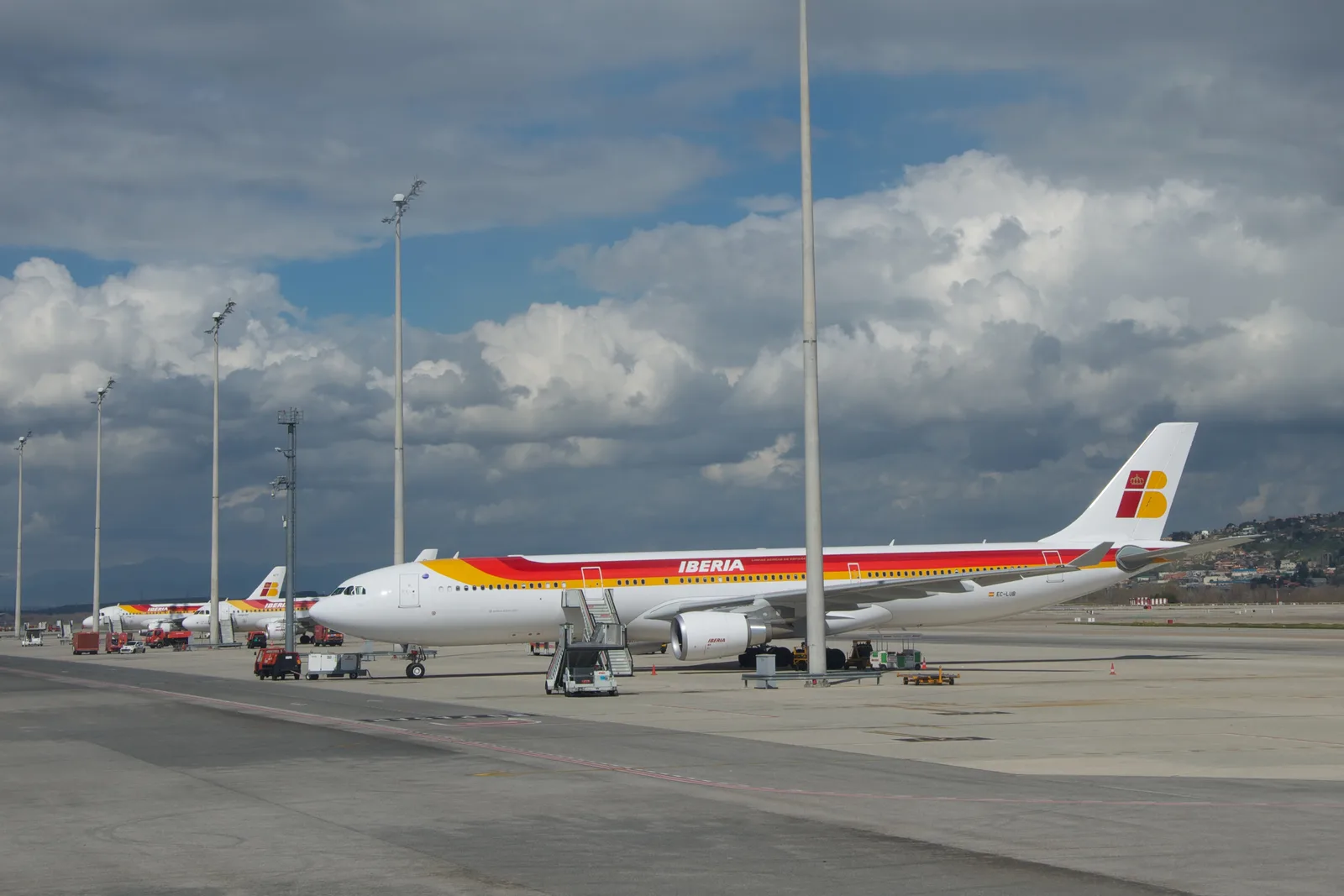
Madrid Airport Airlines
Adolfo Suárez Madrid Airport (MAD) hosts more than eighty airlines from every corner of the world, making it one of the most diverse aviation hubs in Europe. Whether you are flying intercontinentally with a flagship long-haul carrier, hopping across Europe with a low-cost operator, or connecting to one of the dozens of Latin American destinations served from Madrid, the airline you choose shapes nearly every aspect of your journey — from check-in procedures and baggage allowances to the terminal you depart from and the lounges you can access.
This guide is a complete overview of the airlines that operate at Madrid Airport. It covers the major hub carriers, the alliance partners, the low-cost specialists, and the regional and intercontinental operators that together produce the hundreds of daily flights that move through MAD. Understanding which airline goes where, which alliance they belong to, and what kind of experience to expect will help you make informed booking decisions and navigate the airport with confidence.
Madrid Airport is unusual in that it serves as a primary hub for one major flag carrier (Iberia) while also hosting strong operations from carriers in all three global airline alliances and a substantial low-cost presence. Few European airports offer this combination of long-haul intercontinental connectivity and dense short-haul European coverage at the same scale, and the airline diversity at MAD is one of the practical advantages of flying through Spain's capital.
What is Airlines at Madrid Airport?
Madrid Airport currently hosts more than eighty scheduled passenger airlines plus a number of charter and seasonal operators. The airline mix includes Spain's flag carrier Iberia and its subsidiaries, all major European national carriers, the principal Latin American flag carriers, several North American operators, a meaningful Middle Eastern and Asian presence, and a robust low-cost segment. Together these airlines connect Madrid directly to more than 180 destinations across roughly 70 countries.
The distribution of airlines across the four passenger terminals follows a logical pattern based primarily on alliance membership. Madrid Airport terminals are divided into two physical clusters — the older T1, T2, T3 complex and the newer T4 / T4S complex — and the choice of cluster reflects the underlying alliance and operational arrangements. Iberia and the entire Oneworld alliance operate from T4 and T4S, while Star Alliance, SkyTeam, and most low-cost carriers operate from T1 and T2.
For travelers, the practical implication is that knowing your airline tells you both your terminal and the broader operational style you can expect. Full-service carriers based in T4 typically offer more generous baggage allowances, more inclusive fares, and richer in-flight services. Low-cost carriers based in T1 or T2 typically offer cheaper headline fares but charge separately for baggage, seat selection, and many other services. Neither approach is inherently better — the right choice depends on your priorities and itinerary.
Iberia — Flag Carrier and Biggest Hub Airline
Iberia is the dominant airline at Madrid Airport and the carrier that defines its character as an intercontinental hub. As Spain's flag carrier and a founding member of the Oneworld alliance, Iberia uses MAD as its primary global base, operating dozens of long-haul flights daily alongside an extensive European network. The airline is part of International Airlines Group (IAG), which also owns British Airways, Aer Lingus, Vueling, and Level — giving Iberia substantial backing and network coordination across the group.
Iberia's long-haul fleet at Madrid consists primarily of Airbus A330-200, A330-300, and A350-900 aircraft, used on routes to Latin America (Buenos Aires, São Paulo, Mexico City, Bogotá, Lima, Santiago, Havana, San Juan, and many others), North America (New York, Boston, Chicago, Los Angeles, Miami, Dallas), Asia (Tokyo, Shanghai), the Middle East (Tel Aviv), and increasingly Africa. The carrier's Latin American network in particular is unmatched among European airlines, reflecting Spain's historical and linguistic ties to the region.
Iberia's short and medium-haul European network operates primarily out of T4, with flights to nearly every major European city and most Spanish domestic destinations. The airline's hub structure is designed to facilitate connections between Latin America and Europe, with morning arrival waves from the Americas timed to feed European departures, and evening departure waves to the Americas timed to receive arriving European passengers. This routing makes Madrid one of the most efficient gateways for Europe-Latin America travel.
Frequent flyers can join Iberia Plus, the airline's loyalty program, which offers miles redemption across the Oneworld alliance. Status tiers (Plata, Oro, Platino, Infinita) provide escalating benefits including lounge access, priority handling, and bonus miles. Iberia's lounges in T4 and T4S are among the best in Europe, with the flagship Sala VIP Velázquez offering full-service dining, showers, and quiet spaces.
Iberia Express and Iberia Regional
Beyond Iberia mainline, the IAG group operates two additional brands at Madrid that handle specific segments of the network. Iberia Express is the lower-cost subsidiary that operates short and medium-haul European routes with a leaner cost structure, allowing Iberia to compete more effectively with low-cost carriers on price-sensitive leisure routes. Iberia Express uses Airbus A320 family aircraft and operates from T4, sharing terminal infrastructure with Iberia mainline.
From the passenger perspective, Iberia Express delivers a streamlined version of the Iberia experience — the same Oneworld alliance benefits and Iberia Plus mileage accrual, but with paid extras for things like seat selection, checked baggage on the cheapest fare classes, and onboard food. Connections between Iberia Express and Iberia mainline flights work seamlessly because both operate from T4 with shared infrastructure, making it easy to combine a low-cost short-haul flight with a long-haul Iberia mainline service.
Iberia Regional, operated under partnership with Air Nostrum, handles smaller regional routes within Spain and to nearby European destinations. The fleet consists primarily of Bombardier CRJ regional jets and ATR turboprops, optimized for thinner regional markets. These flights operate from T4 or T2 depending on the specific route. For travelers connecting from a long-haul Iberia flight to a Spanish regional destination, the Iberia Regional service typically integrates with the main itinerary, with through-checked baggage and coordinated booking.
Air Europa
Air Europa is the second-largest Spanish airline and the second most significant carrier at Madrid Airport. Headquartered in Palma de Mallorca and owned by the Globalia tourism group, Air Europa operates a substantial network of long-haul flights to Latin America and the Caribbean alongside an extensive short and medium-haul European operation. The airline has historically been a member of the SkyTeam alliance, although its alliance status has been subject to change with proposed mergers within IAG.
Air Europa's long-haul fleet centers on Boeing 787 Dreamliners, used on routes to destinations including Buenos Aires, São Paulo, Lima, Santo Domingo, Havana, Cancún, New York, and Miami. The airline's Caribbean and Central American network is particularly strong, offering competitive alternatives to Iberia on key routes. Short and medium-haul operations use Boeing 737 aircraft on European and North African routes.
For travelers, Air Europa typically offers competitive fares relative to Iberia on long-haul routes where the two carriers compete, with broadly comparable service standards in business class. The airline's loyalty program, Air Europa SUMA, provides miles accrual and status benefits, with reciprocal benefits for SkyTeam frequent flyers. Air Europa operates from T2 at Madrid, separate from the Oneworld carriers at T4.
Oneworld Alliance Carriers at MAD
Beyond Iberia and Iberia Express, several other Oneworld alliance members operate substantial services at Madrid Airport, leveraging the alliance's hub structure to provide seamless connections. British Airways operates multiple daily flights between Madrid and London Heathrow as part of IAG's coordinated network, with frequent connections to British Airways' worldwide route map. American Airlines flies daily between Madrid and New York JFK, Dallas, Miami, and Chicago, providing direct US connectivity for American passengers and Iberia frequent flyers.
Cathay Pacific operates a daily flight between Madrid and Hong Kong, providing the only direct connection between Spain and Hong Kong and a useful gateway to Asia for Iberia Plus members. Qatar Airways offers multiple daily flights between Madrid and Doha, connecting Madrid to Qatar Airways' extensive Middle Eastern, Asian, African, and Australian network. Finnair flies between Madrid and Helsinki, offering connections to Finnair's strong Asian network. Royal Jordanian connects Madrid to Amman with onward connections to the Middle East.
Iberia Plus members and other Oneworld frequent flyers can access lounges, earn miles, and enjoy alliance benefits across all of these carriers. The alliance structure makes Madrid one of the strongest Oneworld hubs in Europe, with comprehensive coverage across long-haul intercontinental routes and seamless integration with Iberia's European feeder network. For travelers planning multi-segment Oneworld itineraries, MAD is among the most efficient European connection points.
Star Alliance Carriers at Madrid
Star Alliance, the largest of the three global airline alliances by member count, is well represented at Madrid Airport with several major members operating frequent services. Lufthansa operates multiple daily flights between Madrid and Frankfurt and Munich, providing extensive connections to Lufthansa's German hubs and onward to its global network. Swiss International Air Lines flies between Madrid and Zurich, while Austrian Airlines connects Madrid to Vienna.
Turkish Airlines operates one of the more important non-European routes from Madrid, with multiple daily flights to Istanbul providing connections across Turkish Airlines' extensive network reaching nearly every continent. United Airlines flies between Madrid and Newark, providing direct US connectivity through United's New York-area hub with onward connections across North America. Air Canada operates seasonal services between Madrid and Toronto and Montreal.
Star Alliance members at Madrid operate primarily from T1, with their lounges and check-in facilities concentrated there. The Sala VIP Cibeles lounge at T1 is the principal Star Alliance lounge at Madrid, accessible to Star Gold members, business and first-class passengers, and lounge-pass holders. For travelers loyal to Star Alliance airlines (United Mileage Plus, Lufthansa Miles & More, Aegean Miles+Bonus, Singapore KrisFlyer, etc.), Madrid offers reasonable connectivity within the alliance, though the network is less dense than at Frankfurt, Munich, or Vienna.
SkyTeam Carriers at Madrid
SkyTeam is the third major alliance with a presence at Madrid Airport, anchored historically by Air Europa as the home Spanish carrier within the alliance, alongside several other significant members. Air France operates multiple daily flights between Madrid and Paris Charles de Gaulle, connecting Madrid to Air France's extensive long-haul network and the broader SkyTeam system. KLM flies between Madrid and Amsterdam Schiphol, similarly offering global connectivity through KLM's Dutch hub.
Delta Air Lines operates direct flights between Madrid and New York JFK, Atlanta, and seasonally to other US destinations, providing the principal SkyTeam US connectivity. Aerolineas Argentinas connects Madrid to Buenos Aires Ezeiza with daily flights, offering a SkyTeam alternative to Iberia and Air Europa on the heavily-trafficked Argentina route. Aeroméxico operates between Madrid and Mexico City. Korean Air flies between Madrid and Seoul Incheon, providing an East Asian connection.
SkyTeam carriers at Madrid operate from various terminals depending on the specific airline — Air France and KLM from T2, Delta and other transatlantic operators from T1, and so on. The alliance's lounge presence at Madrid is somewhat fragmented compared to Oneworld and Star Alliance, but Air France-KLM operates a lounge accessible to SkyTeam Elite Plus members and premium-cabin travelers. For frequent flyers loyal to Delta SkyMiles, Air France-KLM Flying Blue, or other SkyTeam programs, Madrid offers solid alliance coverage.
Low-Cost Carriers — Ryanair, easyJet, Vueling, Wizz Air
Madrid Airport hosts a substantial low-cost carrier presence, reflecting Spain's importance as a leisure travel market and the broader European trend toward low-cost dominance on short-haul routes. Ryanair operates its largest Spanish base at Madrid, with services from T1 to dozens of European destinations including extensive networks to Italy, the United Kingdom, Ireland, Germany, France, and Eastern Europe. The airline's operating model emphasizes low headline fares with separate charges for nearly all extras including baggage, seat selection, priority boarding, and even certain check-in options.
easyJet operates from Madrid to multiple European destinations with a particular focus on the United Kingdom and France. The airline operates from T2 and offers a slightly more inclusive product than Ryanair, with one cabin bag included free in most fares. Vueling, the IAG-owned Spanish low-cost carrier, has a substantial presence at Madrid with flights to most European countries and to selected North African destinations. Vueling operates from T4 alongside Iberia, allowing for some interlining benefits within the IAG group.
Wizz Air, the Hungarian-Romanian low-cost specialist focused on Central and Eastern European routes, operates from Madrid to destinations including Budapest, Bucharest, Warsaw, Vilnius, and others. The airline's offering follows the standard low-cost model with paid extras for most services. For travelers prioritizing price over convenience, low-cost carriers at Madrid offer competitive fares to a wide range of European destinations, particularly when booked well in advance and with minimal extras. Always factor in baggage and seat selection charges when comparing prices to full-service carriers.
Latin American Carriers and Routes from MAD
Madrid Airport's most distinctive feature among European hubs is its dense network of routes to Latin America, served not only by Iberia and Air Europa but also by a number of Latin American flag carriers and specialist operators. LATAM operates flights between Madrid and São Paulo, Lima, and seasonally other South American destinations, leveraging the carrier's network across the continent. Avianca connects Madrid to Bogotá and onward across Avianca's Colombian and Central American network.
Aerolineas Argentinas, mentioned among SkyTeam carriers, provides daily Buenos Aires service. Aeroméxico connects to Mexico City. COPA Airlines flies between Madrid and Panama City, where the airline's Hub of the Americas provides connections across Central and South America. Cubana de Aviación, the Cuban flag carrier, operates between Madrid and Havana with onward services. Plus Ultra and Iberojet offer additional capacity on certain Latin American routes.
For travelers heading to Latin America, the airline choice often involves trading frequency, schedule, and price across multiple options. Iberia and Air Europa typically offer the most frequencies and most flexible scheduling on major routes, while LATAM and the local flag carriers may offer better connections at the destination end. Comprehensive route information for the broader airport network is on our flights to and from MAD page.
North American Carriers and Routes
The transatlantic market between Madrid and North America is served by both Spanish and American carriers, with significant frequency on the most-trafficked routes. Iberia operates the most extensive Madrid-US network, with daily flights to New York JFK, Boston, Chicago O'Hare, Dallas Fort Worth, Los Angeles, Miami, Washington Dulles, and seasonally other destinations. American Airlines, as Iberia's Oneworld partner, operates several of these same routes either directly or in codeshare.
Delta Air Lines flies between Madrid and New York JFK and Atlanta, with seasonal services to other US destinations through SkyTeam codeshares. United Airlines connects Madrid to Newark Liberty, providing access to United's New York-area hub. Air Canada operates seasonal services between Madrid and Toronto Pearson, with summer-season frequencies higher than winter. Smaller charter operators serve specific seasonal markets including ski destinations and leisure routes.
For travelers heading to specific US cities, the most relevant question is often whether direct service exists or whether a connection through a major hub is required. Madrid offers direct service to roughly a dozen US destinations, which covers most major business and leisure markets. For destinations beyond the direct network, connections are typically routed through New York, Miami, or Dallas (via Iberia/American), through Atlanta (via Delta), or through Newark (via United). Comprehensive arrival timing for these routes is detailed in our arrivals information coverage.
Asian and Middle Eastern Carriers
Madrid's connectivity to Asia and the Middle East has expanded significantly in recent years as Asian and Gulf carriers have added Madrid to their European networks. Qatar Airways operates multiple daily flights between Madrid and Doha, providing the most extensive single-carrier connectivity to Asia, the Middle East, Africa, and Australasia from Madrid. The airline's Doha hub allows convenient connections to dozens of destinations across these regions.
Emirates flies between Madrid and Dubai daily, with onward connections across the Emirates network reaching virtually every major destination in Asia, Africa, Australasia, and the Indian subcontinent. Etihad Airways connects Madrid to Abu Dhabi, providing similar connectivity through the Etihad network. Turkish Airlines, mentioned earlier among Star Alliance carriers, offers extensive connectivity through Istanbul.
Direct East Asian service from Madrid includes Cathay Pacific to Hong Kong (Oneworld) and Korean Air to Seoul Incheon (SkyTeam), plus Iberia's direct service to Tokyo Narita and Shanghai Pudong. China Eastern and several other Chinese carriers have operated to Madrid in various periods. For Indian subcontinent travel, the most efficient routings typically involve connections through Doha, Dubai, or Istanbul rather than direct Madrid-India services, which have come and gone over the years.
African Carriers and Routes
Madrid's African connectivity is more modest than its Latin American or European networks but still provides direct service to several major African destinations. Royal Air Maroc operates between Madrid and Casablanca, providing connections across Morocco and to Royal Air Maroc's broader African network. Tunisair flies to Tunis seasonally. Air Algerie operates services to Algiers.
For sub-Saharan African destinations, direct service from Madrid is limited. Iberia operates seasonal flights to certain destinations and has explored adding routes to West and Southern Africa, with the network varying by year. Ethiopian Airlines, the African Star Alliance member, has operated services to Madrid in certain periods, providing connections through Addis Ababa to dozens of African cities. For most sub-Saharan African travel, connections through Frankfurt, Paris, Istanbul, or Dubai are typically more efficient than seeking direct service from Madrid.
South African Airways has operated services to Madrid in some periods. EgyptAir flies to Cairo, providing one direct connection to North Africa with onward service across EgyptAir's network. The pattern of African service from Madrid reflects the broader competitive landscape in which a few carriers maintain selective European routes while most travelers connect through major intercontinental hubs.
Charter and Seasonal Operators
Beyond the scheduled airlines, Madrid Airport hosts a number of charter and seasonal operators that handle specific markets. Iberojet (formerly Evelop) operates charter and scheduled long-haul flights to Caribbean and South American destinations, often serving the Spanish leisure market with package-tour operations. Plus Ultra similarly operates leisure-oriented long-haul services. Wamos Air provides ACMI (aircraft, crew, maintenance, and insurance) operations for various carriers.
Seasonal European leisure services significantly increase Madrid's network during summer months, with charter operators bringing additional capacity from European source markets to Spanish leisure destinations and vice versa. Many of these flights are sold through tour operators rather than directly to consumers, so they may not appear in standard airline searches but represent meaningful capacity in the airport's overall traffic.
For travelers booking through tour operators or seeking the lowest fares to leisure destinations, charter operators sometimes offer significantly better prices than scheduled carriers. The trade-off is typically less flexibility, more limited refund options, and inclusion in package deals rather than as standalone flights. Always confirm terms and conditions when booking charter services, as they often differ from standard airline terms.
Choosing the Right Airline for Your Needs
With more than eighty airlines to choose from on most major routes, the question of which airline to fly often involves balancing multiple factors. Price is the most obvious factor, and low-cost carriers typically offer the cheapest headline fares for European routes. However, baggage charges, seat selection fees, and other extras can significantly close the gap with full-service carriers, particularly for travelers with checked bags or those who value seat selection.
Schedule and frequency matter especially for business travel and tight connections. Iberia and Air Europa together offer the most flexibility on most Spanish-related routes, with multiple daily frequencies on heavily-trafficked sectors. Long-haul travelers should consider connection times at Madrid carefully, especially when changing between terminal clusters. Our Madrid Airport guide covers connection logistics in detail.
Frequent flyer program membership often tilts the choice toward a specific airline or alliance, particularly for travelers earning status. Iberia Plus offers strong value on long-haul redemptions to Latin America. Star Alliance loyalists may prefer Lufthansa or Turkish Airlines from Madrid. SkyTeam members may favor Air France or KLM. The benefits of status — lounge access, priority handling, baggage allowances — can substantially improve the travel experience.
For travelers with no strong preference, comparing total fare (including expected baggage and seat selection charges) and total journey time (including any connections) on the major booking sites typically identifies the best option for a specific itinerary. Madrid's airline diversity ensures that for nearly any route and budget, some reasonable choice exists. For specific departure-side timing and procedures, see our departures information. The airline's experience often matters less than the underlying convenience of schedule, price, and routing for any specific journey.
Need help with airline-specific questions? Contact us.
You May Also Like
- Madrid Airport (MAD)
- Madrid Airport Terminals
- Flights from and to Madrid Barajas Airport
- Madrid Airport Guide
Plan your trip — airport routes
 AranjuezCity
 ÁvilaCity
 CuencaCity
 El Escorial (San Lorenzo)City
 SegoviaCity
 ChuecaNeighborhood
 Gran VíaNeighborhood
 La LatinaNeighborhood
 LavapiésNeighborhood
 MalasañaNeighborhood
 MoncloaNeighborhood
 Puerta del Sol (City Centre)Neighborhood
 Salamanca districtNeighborhood
 ValdebebasNeighborhood
 Chamartín railway stationStation
 Nuevos MinisteriosStation
 Príncipe Pío stationStation
 Casa de CampoVenue
 Cívitas Metropolitano (former Wanda Metropolitano)Venue
 IFEMA Feria de MadridVenue
 Madrid RíoVenue
 Plaza de EspañaVenue
 Plaza MayorVenue
 Prado MuseumVenue
 Reina Sofía MuseumVenue
 Retiro ParkVenue
 Royal Palace of MadridVenue
 Santiago Bernabéu StadiumVenue
 Thyssen-Bornemisza MuseumVenue
 Valle de los Caídos (Cuelgamuros)Venue