Madrid Airport Guide — Everything You Need to Know About MAD
Adolfo Suárez Madrid–Barajas Airport (IATA: MAD, ICAO: LEMD) is more than just Spain's busiest airport — it is the gateway to the Iberian Peninsula and one of Europe's most strategic aviation hubs. For travelers arriving in or departing from Spain's capital, the experience of moving through MAD shapes a significant part of the journey. Knowing how the airport works, where things are, and what to expect makes the difference between a smooth trip and one filled with avoidable stress.
This guide brings together everything you need to navigate Madrid Airport with confidence. It covers the practical realities — terminals, transport, security, facilities — alongside the kind of insider knowledge that comes from understanding how a major hub actually operates day to day. Whether you're a first-time visitor connecting to a Spanish vacation or a seasoned traveler with frequent business in Iberia, the information here is designed to make your time at MAD as efficient and pleasant as possible.
Madrid Airport handled approximately 60 million passengers in 2023, with traffic continuing to grow each year. It is the principal hub of Iberia and a major base for Air Europa and Ryanair, with extensive intercontinental connectivity to Latin America, North America, the Middle East, and increasingly to Asia and Africa. Its position as Spain's primary international gateway means that understanding it well pays dividends every time you fly through.
Introduction to Madrid Barajas Airport (MAD/LEMD)
Madrid Barajas, officially renamed Adolfo Suárez Madrid–Barajas in 2014 in honor of Spain's first democratically elected prime minister of the post-Franco era, is located approximately 12 kilometers northeast of central Madrid. The airport sits in the Barajas district of the Spanish capital, easily accessible by metro, commuter rail, bus, and road. Its proximity to the city center is one of its practical advantages — many international airports require longer transfers than MAD does.
The airport occupies a vast site of more than 3,000 hectares, with four passenger terminals, multiple runways, and extensive cargo facilities. It serves as the principal hub for the Madrid Airport (MAD) ecosystem of Spanish aviation, handling more than 90 percent of all flights between Spain and Latin America. This Latin American connection is one of MAD's defining characteristics — no other European airport rivals its reach across the Spanish-speaking world.
Operationally, the airport is managed by AENA (Aena Aeropuertos), the Spanish state-owned airport operator that runs nearly all of Spain's commercial airports. AENA's operational standards at MAD are generally high, with continuous investment in terminal upgrades, technology, and passenger services. The airport regularly receives strong rankings in European airport quality assessments and continues to modernize its facilities to handle growing demand.
Airport History and Recent Developments
Madrid Barajas opened in 1931, making it one of Spain's oldest civilian airports. Its early history was shaped by the political turbulence of the twentieth century — civil war, dictatorship, and isolation gave way, after Spain's transition to democracy and entry into the European Economic Community, to a period of remarkable expansion. From the 1980s onward, MAD grew rapidly to support Spain's emerging role as a major tourist destination and global business presence.
The most significant transformation in the airport's modern history was the 2006 opening of Terminal 4 (T4) and its satellite Terminal 4S. Designed by the British architect Richard Rogers in collaboration with Spanish firm Estudio Lamela, T4 doubled the airport's capacity overnight. The terminal won the Stirling Prize in 2006 for its distinctive bamboo-clad ceilings and undulating curves, becoming an architectural landmark in its own right. Iberia and the entire Oneworld alliance moved to T4 and T4S, consolidating long-haul operations.
More recent developments include extensive renovations of T1, T2, and T3 to bring them up to contemporary standards, expansion of the airport's metro and rail connections, and the addition of automated border control gates for European Union and Schengen passport holders. The airport has also invested heavily in sustainability initiatives, including solar power installations, LED lighting upgrades, and electric ground equipment, with an ambition to achieve net-zero operations by 2026.
Terminal Map and Orientation
Madrid Airport's four terminals serve different functions and airlines, and understanding which terminal corresponds to your flight is the first step in a smooth airport experience. T1, T2, and T3 are physically connected and form what locals call the "old terminals" — they share a contiguous building complex and you can walk between them. T4 and its satellite T4S are located several kilometers away from the T1–T3 complex and require either airside or landside transport between them.
T1 handles non-Schengen international flights from a wide range of carriers, including Air Europa, Ryanair (most routes), and many Latin American and Middle Eastern airlines. T2 serves Schengen-area flights, predominantly low-cost carriers operating within Europe. T3 is currently the smallest and is primarily used for some domestic and Schengen routes, though its role has changed several times over the years and remains subject to operational adjustments. T4 and T4S house Iberia and the entire Oneworld alliance, including Iberia's transatlantic operations and code-share partners.
For an in-depth breakdown of each terminal's airlines, gates, and facilities, see the dedicated guide on Madrid Airport terminals. Always check your boarding pass or airline confirmation for the assigned terminal — at busy times of year (summer, Christmas, Easter), terminal assignments occasionally shift to balance load, and the correct terminal will be confirmed at check-in.
Airline Alliances at Madrid (Star Alliance, Oneworld, SkyTeam)
Madrid Airport is unusual among major European hubs in hosting members of all three major global airline alliances. Oneworld has the strongest presence, anchored by Iberia at T4/T4S. Star Alliance and SkyTeam carriers also serve MAD extensively, though primarily out of T1 and the smaller terminals. This alliance diversity makes Madrid an unusually flexible city for travelers regardless of frequent flyer affiliation.
Oneworld at MAD includes Iberia (the largest tenant), British Airways, American Airlines, Iberia Express, LATAM (with several South American routes), Royal Jordanian, Cathay Pacific, Qatar Airways, Finnair, and others. The Oneworld lounge network at T4 is among the more extensive in Europe, with dedicated Iberia premium lounges and access privileges for status holders across the alliance. For frequent flyers using Oneworld benefits, MAD is one of the better European hubs for accumulating and redeeming benefits.
Star Alliance is represented at MAD by Lufthansa, Swiss, Austrian Airlines, Turkish Airlines, United Airlines, Avianca, COPA, Air China, and others, mostly operating from T1. SkyTeam includes Air France, KLM, Delta, Air Europa, Aerolineas Argentinas, and others. Knowing which alliance you're flying helps with lounge access, baggage allowances, and connection benefits — particularly important when itineraries involve multiple carriers. Look up the full list of airlines flying to MAD for current operations.
Major Airline Hubs (Iberia, Air Europa, Ryanair)
Iberia is the dominant carrier at Madrid Airport, operating the lion's share of long-haul flights and a substantial European network. As Spain's flag carrier and a member of the IAG group (which also includes British Airways, Aer Lingus, Vueling, and Level), Iberia uses MAD as its primary global hub. Its long-haul fleet of A330s and A350s connects Madrid to virtually every major Latin American capital, several US destinations, and increasingly to Asian and African cities. Iberia Express, the carrier's lower-cost European subsidiary, operates a substantial fleet of A320s on intra-European leisure and business routes.
Air Europa, the second-largest Spanish carrier, is also based at MAD with its own network of long-haul flights, particularly to Latin America and the Caribbean. Air Europa has been the subject of repeated merger discussions with Iberia/IAG; whether or not these are completed, the airline remains a significant presence at the airport with its 787 Dreamliner fleet on long-haul and a healthy short/medium-haul European operation.
Ryanair, the European low-cost giant, has its largest Spanish base at MAD and operates from T1. Its presence has grown substantially in recent years, offering point-to-point connections to dozens of European cities at competitive prices. Ryanair's operating model is different from that of full-service carriers — be aware of strict baggage rules, separate paid services for many things included free elsewhere, and prompt boarding gate closure times. For travelers using Ryanair through MAD, arriving early and being prepared with the airline's specific procedures is essential.
Airport Layout — Finding Your Way Between Terminals
The most important thing to understand about MAD's layout is that T4 and T4S are physically separated from T1, T2, and T3. The distance between the two complexes is approximately 2.5 kilometers, requiring transport between them. Free shuttle buses run continuously between the terminal areas during operational hours, taking approximately 10 minutes airside (after security, with airline tickets) or 15 to 20 minutes landside (outside security, available to anyone).
Within the T1–T2–T3 complex, you can walk between any of the three terminals through the connected concourses, though the walk from one extreme to the other can take 10 to 15 minutes including security barriers. T4 connects to T4S via an underground people mover (a kind of subway-like train), which runs continuously and takes about three minutes. The people mover is automatic and easy to use — follow signs from T4 toward "Satellite" or "T4S" and the train arrives every minute or two.
If you have a tight connection between two different terminal complexes (T1/T2/T3 to T4 or vice versa), you should generally allow at least 90 minutes between flights. Domestic-to-domestic and Schengen-to-Schengen connections within the same terminal can be much faster (45 to 60 minutes is realistic), but inter-terminal connections, particularly involving baggage handling and security re-screening, take more time. Iberia and Oneworld carriers have minimum connection times built into their booking systems that account for this.
Inter-Terminal Transport and Connections
The free inter-terminal bus is one of the most useful features of MAD for travelers connecting between flights or visitors attempting to navigate the entire airport. The buses run on a continuous loop, with two main routes: a landside service (anyone can use it) and an airside service (only available to passengers with valid boarding passes who have cleared security in their departure terminal).
The landside bus stops at all four terminals at clearly marked terminal exits. It runs roughly every 5 to 10 minutes during peak hours and every 15 to 20 minutes during off-peak hours. The airside service is faster (no security re-screening) and runs less visibly — ask your airline or check the airport signage for the airside bus pickup location, which is typically near transfer-passenger areas.
For travelers with luggage, particularly heavy or multiple bags, the landside bus has dedicated luggage space, but the bus can become crowded at peak times. If you have a tight connection or significant luggage, the airside bus is generally preferable. Note that many airline transfer desks at MAD will provide guidance on the most efficient route for your specific itinerary, and Iberia/Oneworld carriers have dedicated staff to assist passengers with terminal transfers between connected flights.
Check-In and Security Tips
Most airlines at MAD offer multiple check-in options: traditional staffed counters, self-service kiosks (now widely available across all terminals), and mobile/web check-in. For most flights, online check-in opens 24 to 48 hours before departure and is the fastest option, allowing you to skip directly to security if you have only carry-on luggage. Bag drop-off counters at the airport are typically much faster than traditional check-in counters and are a good time-saver.
Security screening at MAD generally moves efficiently, but processing times vary considerably by terminal and time of day. T4 and T4S typically have the most streamlined security operations, while T1 can experience significant queues during peak departure waves. For peace of mind, arriving 2 hours before a Schengen flight, 2.5 hours before non-Schengen European flights, and 3 hours before long-haul international flights is a reasonable buffer. Iberia Plus elite members and other status passengers have access to fast-track lanes that can significantly reduce security time.
Liquids restrictions apply as standard across the EU — containers up to 100ml must be in a single transparent 1-liter zip-lock bag. New CT scanners are being progressively rolled out at MAD that allow liquids and laptops to remain in bags, but the deployment is incomplete; assume traditional rules unless signage indicates otherwise. Power banks must be in carry-on, not checked baggage, and standard restrictions on sharp objects, sporting goods, and tools apply.
Departure Preparation — Arrival Times and Document Requirements
The amount of time you should plan for at MAD before departure depends on your flight type, terminal, and personal circumstances. As a general rule, plan to arrive at the airport at least 2 hours before a Schengen-area flight, 2.5 hours before non-Schengen European or short international flights, and 3 hours before long-haul intercontinental flights. These are floor recommendations — adding 30 to 45 minutes during peak summer or holiday seasons is wise.
Document requirements vary by destination. For Schengen-area flights, EU/EEA/Swiss citizens need only a valid national identity card or passport. Non-EU citizens flying within the Schengen area still need a passport (and visa if required). For non-Schengen destinations, all passengers need passports valid for the appropriate period (often six months beyond the return date), plus any required visas, electronic travel authorizations, and supporting documents like return tickets or accommodation confirmations.
If you're traveling with children, especially without both parents, additional documentation may be required including consent letters and birth certificates depending on your nationality and destination. Pets require specific paperwork, vaccination records, and often advance booking with the airline. Sports equipment, musical instruments, and special baggage often require pre-arrangement and may incur additional fees. Always check directly with your airline well in advance for any non-standard situations.
Arrival Procedures for International and Schengen Flights
The arrival experience at MAD differs significantly depending on whether you're arriving from inside or outside the Schengen Area. Schengen arrivals are essentially domestic in nature — there's no passport control, you proceed directly from the gate to baggage claim. Non-Schengen international arrivals require passport control before reaching baggage. The Schengen area includes most EU countries plus a few non-EU members like Switzerland, Norway, and Iceland, but excludes Ireland, the UK, and several other countries.
For non-Schengen arrivals, EU/EEA passport holders can use automated e-gates if eligible (valid biometric passport required), which significantly speeds processing. Non-EU travelers go through staffed passport control booths. Processing times vary — in low season, immigration can be a 5-minute wait; during peak times with multiple long-haul flights arriving simultaneously, queues can stretch to 30 to 45 minutes.
After passport control (or directly from the gate for Schengen arrivals), baggage claim is typically efficient at MAD, with bags appearing within 15 to 30 minutes of arrival. Customs is a final step but typically quick — most travelers proceed through the green "Nothing to Declare" channel. Then you reach the public arrivals hall, where transport options to the city begin. For specific guidance on arrival logistics, see Madrid Airport arrivals coverage.
Airport Facilities — Restaurants, Shops, Lounges, Currency Exchange
MAD has invested significantly in passenger experience, particularly in T4 and T4S where the dining and shopping options compare favorably with other major European hubs. T4 offers everything from quick Spanish tapas bars and pintxo counters to upscale restaurants serving regional Spanish cuisine, plus international chains and cafés. The Spanish ham (jamón) experience is a particular highlight — multiple jamón specialty bars allow travelers to try Iberian acorn-fed jamón that is hard to find outside Spain.
Shopping ranges from typical airport offerings to luxury fashion and tax-free goods. Spanish brands like Camper (shoes), Lupo (handbags), and Loewe have substantial presence. The duty-free shops in the international zones offer competitive prices on Spanish wines, olive oil, jamón, and turron. T1, T2, and T3 have more modest retail and dining than T4, but still cover essentials.
Currency exchange offices and ATMs are available throughout all terminals, though exchange rates at the airport are typically less favorable than in city banks. WiFi is free throughout the airport (look for "AENA WIFI"). Charging stations are widely distributed but can become crowded at peak times. Pharmacies, post offices, smoking lounges (in non-Schengen areas of T4 and T4S), and chapels are all available. Lounges are extensive — Iberia, Oneworld carriers, and Star Alliance members operate dedicated facilities at their terminals, plus several pay-per-use lounge options including Plaza Premium, Sala VIP Cibeles, and others.
Family Travel and Accessibility Services at MAD
Madrid Airport is generally family-friendly, with several specific provisions for travelers with young children. All terminals have designated family bathrooms with changing tables, baby-friendly nursing rooms, and stroller-accessible areas. Most major airlines allow families with young children to board priority. For long layovers with children, T4 has a designated children's play space. Children's meal options are available at most major restaurants, and several cafés have high chairs.
AENA operates a comprehensive accessibility program at all Spanish airports including MAD, called "Sin Barreras" ("Without Barriers"). The service is free to passengers who request it in advance through their airline at least 48 hours before travel, though it can sometimes be arranged at shorter notice. Services include wheelchair assistance, escort through the airport, help with luggage, priority boarding, and assistance during connections.
The airport infrastructure is designed for accessibility, with elevators between all levels, accessible bathrooms, lowered counters at check-in, accessible parking, and audio/visual announcement systems. Service animals are welcome with appropriate documentation. For travelers with hearing impairments, T4 and T4S have audio loop systems at many information desks and gates.
Travel Apps and Digital Tools for the Airport
Several digital tools enhance the MAD experience. The official AENA app provides real-time flight information, terminal maps, walking time estimates between gates, and amenity locations. The app also enables service requests like accessibility assistance and lost luggage reports. It's available in Spanish, English, and several other languages and is genuinely useful for navigation, particularly for first-time visitors to a complex airport.
Iberia's app is similarly polished for passengers flying with that carrier — it handles check-in, boarding pass storage, baggage tracking, and seat selection, and integrates with airport navigation in T4 and T4S. Other major airlines at MAD have their own apps with varying degrees of integration. For ground transportation, the Madrid Metro app, the Cercanías Renfe app for commuter rail, and ride-hailing apps (Uber, Cabify, Bolt) all have substantial coverage of the airport.
Translation apps are useful for non-Spanish speakers — Google Translate has offline modes that work even without WiFi. Currency conversion apps help with on-the-spot purchase decisions. For long layovers, downloading entertainment in advance is wise, as airline streaming services may not always work reliably and the airport WiFi, while functional, is not always fast enough for high-quality video streaming.
Common Mistakes Travelers Make at Madrid Airport
Several mistakes recur frequently among travelers at MAD, and avoiding them can save significant frustration. The most common is underestimating the time needed to transfer between T1/T2/T3 and T4/T4S — assuming the inter-terminal bus is quick or always immediately available leads to missed connections. Build in 90 minutes minimum between flights at different terminal complexes, and 60 minutes within the same complex.
Another frequent mistake is showing up too early or too late. Arriving 4 hours before a flight gives you significant idle time at the airport (which has good amenities but isn't designed as a destination); arriving an hour before a flight is risky during peak season. The 2-3 hour window covers most situations comfortably.
Forgetting that many small purchases (water, snacks) at airport restaurants are significantly more expensive than at city center prices is another common surprise. Bringing an empty water bottle to refill from drinking fountains saves money and reduces single-use plastic. Misunderstanding terminal assignments — particularly assuming all Iberia flights leave from T4 — leads to confused arrivals at the wrong building. Always confirm your terminal at check-in or via your boarding pass before traveling to the airport.
Tips for First-Time Visitors
If this is your first arrival at MAD, several practical tips help orient you. First, the airport's signage is multilingual (Spanish, English, sometimes Portuguese, French, and others depending on terminal area), and following signs is generally reliable. Second, ground transport is well-connected and frequent — you don't need to immediately rush to your hotel; take a moment in the arrivals hall to get oriented, withdraw cash if needed, and confirm your transport plan.
For getting to the city, the metro is the cheapest option but involves a transfer at Nuevos Ministerios; the Cercanías commuter train is simpler if your destination is near Atocha or Chamartín stations. Taxis from MAD have a fixed rate of 30 euros to most central Madrid destinations, making them a reasonable choice for groups or those with significant luggage. Ride-hailing services (Uber, Cabify) are also widely available and often cheaper than taxis. Detailed coverage of all options is in getting to Madrid city center and airport transfers guides.
For a first stay in Madrid, consider booking a hotel near the airport for the first night if your flight arrives late or if you need to acclimate to the time zone. Several hotels are walking distance from terminals or accessible by free shuttle — see the hotels near MAD guide for recommendations. If you're departing on an early morning flight, booking an airport-area hotel the night before is often more relaxed than racing through traffic at dawn from central Madrid.
Lastly, embrace some Spanish hospitality and cuisine while you're at MAD — even with limited time, the jamón experience, a quick café con leche, or Spanish wine sampling at one of the wine bars in T4 makes the airport experience itself a welcome introduction to Spain. If you're using parking at the airport, book online in advance for substantial savings versus drive-up rates. And if your trip involves a longer wait, consult the layover guide for ideas on making the most of the time.
Need help planning your trip through Madrid? Get in touch for personalized advice.
You May Also Like
Plan your trip — airport routes
 AranjuezCity
 ÁvilaCity
 CuencaCity
 El Escorial (San Lorenzo)City
 SegoviaCity
 ChuecaNeighborhood
 Gran VíaNeighborhood
 La LatinaNeighborhood
 LavapiésNeighborhood
 MalasañaNeighborhood
 MoncloaNeighborhood
 Puerta del Sol (City Centre)Neighborhood
 Salamanca districtNeighborhood
 ValdebebasNeighborhood
 Chamartín railway stationStation
 Nuevos MinisteriosStation
 Príncipe Pío stationStation
 Casa de CampoVenue
 Cívitas Metropolitano (former Wanda Metropolitano)Venue
 IFEMA Feria de MadridVenue
 Madrid RíoVenue
 Plaza de EspañaVenue
 Plaza MayorVenue
 Prado MuseumVenue
 Reina Sofía MuseumVenue
 Retiro ParkVenue
 Royal Palace of MadridVenue
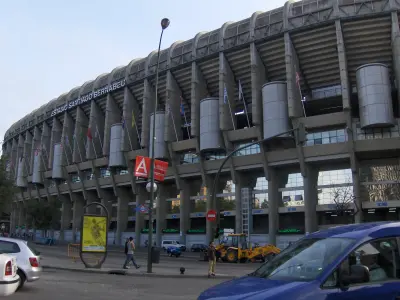 Santiago Bernabéu StadiumVenue
 Thyssen-Bornemisza MuseumVenue
 Valle de los Caídos (Cuelgamuros)Venue