Madrid Airport Departures — A Complete Guide for Travelers
Departing from Madrid Airport (MAD) — officially Adolfo Suárez Madrid–Barajas Airport — is, for most travelers, a smoother experience than the airport's size might suggest. As Spain's largest airport and one of the busiest in Europe, MAD handles around 60 million passengers a year, with departures fanning out to more than 200 destinations across Europe, the Americas, Africa, and Asia. The scale is significant, but the systems that move passengers through the building are reasonably well-organized when you know how they work.
This guide is for travelers who are about to depart from Madrid and want a clear picture of what to expect — how early to arrive, which terminal to head to, what the security and boarding processes actually look like, and what to do if something goes wrong. The goal is to make the airport less of a source of stress and more of a routine step in your journey.
What follows applies to all categories of departure from Madrid: domestic Spanish flights, Schengen-area flights within Europe, and international long-haul flights to non-Schengen destinations. Each category has slightly different procedures, and knowing in advance which one applies to your flight saves time and uncertainty when you arrive at the airport.
What is Departing from Madrid Barajas?
Madrid Barajas operates as a hub airport, which means a substantial share of its traffic is connecting passengers in addition to those starting or ending their journey here. Iberia and its Oneworld partners use Madrid as a primary base, particularly for flights between Europe and Latin America. Air Europa uses the airport as its main hub for SkyTeam connections. Low-cost carriers including Ryanair, easyJet, and Vueling all maintain a strong presence as well, primarily out of Madrid Airport terminals 1 and 2.
Departures from Madrid are spread across four passenger terminals — T1, T2, T3, and the linked T4 / T4S complex — and the choice of terminal depends almost entirely on the airline you are flying with rather than the destination itself. The departures process begins long before you reach security: it includes choosing the right terminal, allowing for transit time between terminals if you've parked or arrived in the wrong one, finding the right check-in zone, and managing your baggage.
The airport is well-signed in Spanish and English, and the staff handling check-in and security are generally accustomed to international travelers. For passengers who are organized about their documents, who arrive with reasonable time to spare, and who follow the basic departures process, Madrid is one of the more pleasant large airports to fly out of in Europe.
Live Departures Information — Where to Check
The most reliable source for live departure information is the official AENA (Aeropuertos Españoles y Navegación Aérea) website and its Madrid Airport mobile app. AENA operates Spain's airport network and maintains real-time flight status, gate assignments, and any delays or cancellations directly from the operations control. The app is free, multilingual, and available on iOS and Android, and it remains the recommended tool for tracking your flight in the hours leading up to departure.
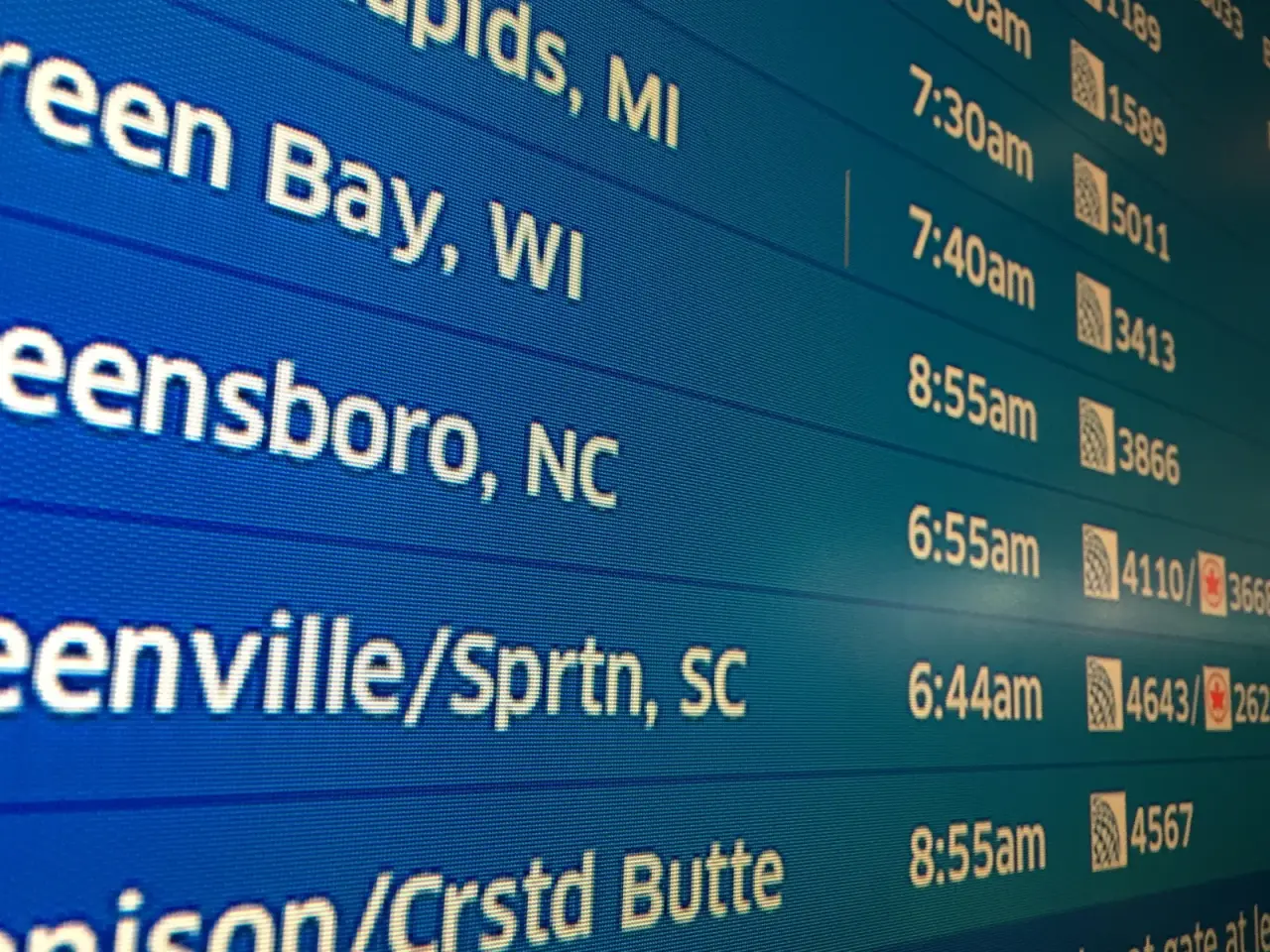
Inside the airport, large information screens distributed throughout each terminal display the same data in real time. These screens typically show the next several hours of departures sorted by time, with airline, destination, flight number, gate or check-in zone, and current status. Status indicators include "Check-in," "Boarding," "Last call," "Departed," and various delay codes. Gates are usually published 30–45 minutes before boarding, sometimes earlier for long-haul flights.
Your airline's own app and website are equally useful. They tend to provide notifications about status changes earlier than the airport-wide systems, particularly for issues like aircraft swaps, schedule changes, or boarding delays. For peace of mind, set up notifications on the airline app, the AENA app, and the airline's check-in confirmation, so any change reaches you through at least one channel.
How Early to Arrive — Schengen vs International, Peak Hours?
The recommended arrival time at Madrid Airport varies by flight type. For Schengen flights — those staying within the Schengen passport-free area, which includes most of mainland Europe — arriving 90 minutes before departure is typically sufficient. The Schengen-only departure flow skips passport control, which removes one step from the process.
For non-Schengen flights, including all flights to the United Kingdom, Ireland, the Americas, Africa, the Middle East, and Asia, arriving 2.5 to 3 hours before departure is the standard recommendation. Long-haul flights from Terminal 4 and T4S in particular benefit from earlier arrival because the walking distances are longer and the satellite terminal requires an underground people-mover.
Peak departure periods at Madrid are typically the early morning (06:00–08:30), late morning (10:30–12:00), and early evening (17:00–19:30). Lines at security and check-in can be considerably longer during these windows, particularly on Mondays, Fridays, and Sundays. If your flight is scheduled during peak hours, add 30 minutes to your buffer.
Adding extra time for high travel periods — Christmas and New Year, Easter (Semana Santa), summer school holidays, and the August holiday weeks when much of Spain travels — is wise even if your flight is technically a Schengen one. The airport handles much higher passenger volumes during these windows, and queues in security and at check-in counters can stretch significantly.
Departure Terminals — Which Terminal for Which Flight
Knowing which terminal handles your departure is essential because the four terminals are physically separated, and traveling between them takes time. The airport's free shuttle bus runs frequently between T1, T2, T3 and T4, but the journey takes around 15–20 minutes and you do not want to be making it 45 minutes before takeoff.
Terminal 1 (T1) handles non-Schengen flights operated by airlines outside the Iberia/Oneworld alliance. This includes most of the airport's North American flights from carriers like American Airlines (some routes), United, Delta, and Air Canada, as well as flights to Asia, Africa, and the Middle East operated by airlines like Qatar Airways, Emirates, Turkish Airlines, and Singapore Airlines. Low-cost long-haul operations also concentrate here.
Terminal 2 (T2) primarily serves Schengen-area flights operated by carriers other than Iberia. Many low-cost European flights — Ryanair, easyJet, Vueling, Wizz Air, and similar — depart from T2. Since Schengen flights don't require passport control, the T2 process tends to be faster overall. Terminal 3 (T3) is a smaller terminal connected to T2 by walkway. It handles a smaller volume of flights, primarily Iberia regional connections and some smaller European carriers.
Terminal 4 (T4) is the largest and most modern of the terminals, and it is the home base for Iberia and other Oneworld carriers (British Airways, American Airlines, Cathay Pacific, Qatar Airways, Royal Jordanian, etc.) for their European Schengen operations. It also handles Air Europa flights. T4 connects via underground people-mover to T4S (T4 Satellite), which handles long-haul, non-Schengen Iberia flights and some Oneworld international departures. Always confirm your departure terminal on your boarding pass or via the AENA flight status before traveling to the airport.
Check-in Procedures — Counters, Online Check-in, Kiosks
Most airlines at MAD offer online check-in, which opens between 24 and 48 hours before departure depending on the carrier. Online check-in is the recommended option for travelers without checked baggage and significantly shortens the airport process. After completing online check-in, you receive a digital boarding pass that you can keep on your phone or print, and you proceed directly to security if you have no bags to drop.
If you have checked baggage, you can still benefit from online check-in by using the dedicated bag-drop counters at the airport, which are typically faster than the full check-in lines. Bag-drop counters are clearly marked at each terminal's check-in zone and are open from approximately three hours before flight time.
Self-service check-in kiosks are available for most major carriers in each terminal. These machines accept your reservation code or passport details, print boarding passes, and in some cases print baggage tags that you then attach to your bags before going to bag-drop. The kiosks are particularly useful for travelers who didn't complete online check-in but don't want to wait in the full counter line.
Traditional check-in counters remain available for travelers who need them — those with special baggage, special requests, group travel, or simply preference for human assistance. Counters open three hours before international flights and two hours before Schengen flights, and they generally close 45 minutes before departure for Schengen flights and 60 minutes before for non-Schengen flights.
Baggage Rules and Drop-off
Baggage rules vary by airline, fare class, and route — there is no universal Madrid Airport baggage policy. The standard for full-service European carriers is one piece of checked baggage up to 23 kg included with most fares (sometimes more for premium classes), and one carry-on plus a personal item. Low-cost carriers typically charge separately for any checked baggage and increasingly charge for carry-on bags as well, with only a small personal item under the seat included in the base fare.
Always check your specific airline's baggage policy before traveling. Excess baggage charges paid at the airport are substantially more expensive than fees paid in advance online — sometimes by a factor of two or three. If you suspect you may exceed the limits, weigh your bags at home and pay any excess online before departure.
For checked baggage, the drop-off process at Madrid is straightforward. You present your boarding pass and ID, the agent weighs and tags your bags, and they go onto the conveyor system. Madrid uses RFID baggage tags for many flights, which improves tracking accuracy. After drop-off, retain the baggage receipt — usually printed on or attached to the boarding pass — until you've collected your bags at your destination.
Special baggage — sports equipment, musical instruments, fragile items, oversized or odd-shaped pieces — typically requires advance notification to the airline and may use specific drop-off counters at the airport. Look for the "Special Baggage" or "Bagaje Especial" signs near the regular check-in area.
Security Control — Fast Track, What to Expect
Madrid Airport's security control is operated by AENA and follows standard EU security regulations. The process is similar to other major European airports: you present your boarding pass at the entry, place liquids in a transparent bag (max 100 ml per container, total 1 liter), remove laptops and large electronics from your bag, remove your jacket and any large metal items, and pass through the body scanner or metal detector while your bags go through X-ray.
The standard liquid restrictions apply (the so-called LAGs rule — liquids, aerosols, and gels). Some terminals at Madrid have begun phasing in newer CT scanners that allow liquids and laptops to remain in bags, but this is not yet uniform across the airport, so plan for the standard procedure to be safe.
Fast track security lanes are available for premium passengers (business and first class), elite frequent flyers in eligible alliance status programs, and any traveler willing to purchase access. Fast track lanes typically save 15–30 minutes during peak periods. Some terminals offer a "Premium Lane" purchased at the entry to security for a small fee — useful when lines are unexpectedly long.
Travelers requiring assistance — those with medical devices, mobility issues, or traveling with infants — can request priority access at security. Inform the agent at the entry to the security area, and they will direct you to an appropriate lane.
Passport Control for Non-Schengen Flights
Travelers departing on non-Schengen flights pass through Spanish passport control after security and before reaching their boarding gate. This includes flights to the UK, Ireland, the Americas, Africa, the Middle East, Asia, and other non-Schengen destinations. EU/EEA citizens and Spanish nationals use dedicated automated gates with biometric e-passport readers, which are fast — usually under a minute per passenger.
Non-EU citizens use the manual passport control lines, where an officer reviews documents and stamps the passport. Wait times in these lines can vary considerably — from a few minutes during off-peak hours to 30+ minutes during peak departure waves. The officer may ask routine questions about your trip, such as length of stay in Spain, accommodation, and reason for visit, particularly if your previous Schengen entries are recent or unusual.
Make sure your passport is valid for the period required by your destination country (often six months beyond your travel date), and that any required visas, transit permits, or entry permissions are in order before reaching passport control. Officers will not let you through if your documents don't meet the destination's requirements, and resolving issues at the airport is generally not possible.
For Schengen flights, no passport control is required at departure — your boarding pass and ID are checked at the gate. Spanish residents and citizens use national ID cards or passports; visitors typically use passports.
Boarding and Gate Procedures
Once through security and passport control (where applicable), you proceed to your departure gate. Boarding gates at Madrid are typically published 30–45 minutes before boarding time. Final boarding usually closes 15–20 minutes before departure, and gates can change with little notice, so monitor the screens in your terminal.
Boarding is typically organized by zones or rows, with priority boarding for premium passengers, families with young children, passengers requiring assistance, and frequent flyer status holders. Most flights pre-board these groups, then board by zones from back to front or by group number depending on the airline's process.
At the gate, you present your boarding pass (digital or paper) and identification. The gate agent scans the pass, the system confirms your booking, and you proceed onto the jet bridge or onto a bus that takes you to a remote-stand aircraft. Bus boarding is more common for low-cost carriers and certain Schengen flights from T2; the bus journey typically takes 5–10 minutes.
Once aboard, the airline's own boarding procedures take over. Stow your bags in the overhead compartments or under the seat in front, take your seat, and prepare for the safety briefing. Most flights from Madrid to Schengen destinations push back on time; long-haul international flights from T4S generally maintain reliable schedules thanks to the route's hub structure.
Lounges, Eating, and Shopping Airside
Madrid Airport hosts multiple lounges across all four terminals, accessible to premium passengers, eligible frequent flyers, and travelers with paid access through programs like Priority Pass, LoungeKey, and Diners Club International. The Iberia Premium Lounge in T4 is the largest and most extensive, with multiple rooms catering to different status tiers — Sala VIP Velázquez for top-tier and business class passengers, and Sala VIP Dalí for additional categories.
The airside dining and shopping at Madrid is extensive, particularly in T4 which has the most options. Restaurants range from quick coffee shops and tapas bars (Mercado Gourmet del Sur, La Tagliatella, 100 Montaditos) to sit-down restaurants serving Spanish and international cuisines. Prices are airport-typical — somewhat higher than in central Madrid, but not unreasonable for travel meals.
Duty-free shopping at Madrid covers spirits, perfume, cosmetics, fashion accessories, electronics, and Spanish specialty foods (Iberian ham, olive oil, wines, turron, etc.). T4 has the largest duty-free area, with multiple specialty boutiques (Hermès, Bvlgari, Gucci, etc.) for premium shoppers.
Spanish food souvenirs make particularly good purchases at Madrid duty-free — vacuum-packed Iberian ham, cheeses, olive oils, and wines are well-presented and competitively priced. Note that some products may have restrictions for entry into your destination country (US, Australia, and others restrict meat and dairy products), so check your destination's rules before buying.
Late or Delayed Departures — Passenger Rights
EU Regulation 261/2004 covers passenger rights for delays, cancellations, and denied boarding for flights departing from EU airports (which includes Madrid) regardless of the airline's nationality. Under EU 261, delays of three hours or more on arrival typically entitle passengers to compensation between €250 and €600 per passenger depending on the flight distance, unless the delay was caused by extraordinary circumstances (severe weather, ATC strikes outside the airline's control, security issues).
For delays of two or more hours, the airline is required to provide refreshments and meals as appropriate. For delays of five or more hours, passengers can request reimbursement of their ticket if they choose not to travel. For overnight delays, the airline must provide accommodation and transport between the airport and accommodation.
If your flight is delayed or cancelled, your first contact should be your airline's representatives at the airport. They are responsible for rebooking you on the next available flight (their own or, if needed, on another carrier), arranging meal vouchers and accommodation if applicable, and processing any compensation claim. Document everything: keep your boarding pass, take photos of the departure board showing the delay, and request a written confirmation of the cause if possible.
For compensation under EU 261, you can submit a claim directly to the airline. If they reject or ignore the claim, third-party services like AirHelp, Flightright, and others handle the process for a percentage fee. Spain's national enforcement body for aviation passenger rights is AESA (Agencia Estatal de Seguridad Aérea), where you can submit complaints if airlines fail to respond.
Special Assistance and Connecting Flights
Madrid Airport provides comprehensive special assistance services through the AENA Special Assistance program (PRM — Persons with Reduced Mobility). The service is free and available to all passengers who request it, but advance notification is required — at least 48 hours before departure through your airline. Assistance covers wheelchair service from the terminal entrance through check-in, security, and boarding; help for travelers with visual or hearing impairments; assistance for elderly travelers; and help for travelers with hidden disabilities.
Families traveling with young children benefit from family-friendly amenities throughout the airport. Strollers can typically be checked at the gate (free of charge) and returned at the destination's gate or baggage claim. The airport has multiple family rooms with diaper-changing tables, breastfeeding chairs, and bottle-warming facilities. Children's play areas are available, particularly in T4. Unaccompanied minors are handled by individual airlines following their own protocols.
Madrid is a major connecting hub. Minimum connection times (MCT) vary by terminal combination. Connections within T4 (Schengen to Schengen) can be as short as 45 minutes, though airlines typically require 60 minutes. T4 to T4S transfers (Schengen to international long-haul) typically require 75–90 minutes. Connections between different terminals (e.g., T1 to T4) require longer minimum times — typically 90–120 minutes for the same airline and 120–180 minutes for different airlines.
If you're booking a connection yourself rather than as a single ticket, ensure the gap is significantly longer than the minimum — at least 2 hours for same-terminal Schengen connections and 3 hours for international transfers. Airlines are generally not responsible for missed self-booked connections.
Tips for Stress-Free Departure from Madrid
The single most important step for a smooth Madrid departure is verifying your terminal in advance. Showing up at the wrong terminal — even by 30 minutes' margin — can compromise the entire process if you have to take the inter-terminal shuttle. Your boarding pass clearly states the terminal; check it the night before and again before leaving for the airport.
Use online check-in if you can. The 30 minutes you save at the airport often makes the difference between rushing and arriving comfortably. Even if you're checking baggage, a printed or digital boarding pass speeds up the bag-drop process considerably.
Keep your boarding pass and passport accessible throughout the airport — you'll need to show them at security entry, at the gate, and (for non-Schengen flights) at passport control. A simple lanyard pouch or front pocket holder reduces the time spent fumbling for documents. For families, organize each person's documents separately and clearly.
Use the AENA app for real-time updates. Notifications about gate changes, boarding starts, and delays come through the app considerably faster than they appear on the public-facing screens. Set the notifications to push, so you don't have to keep refreshing. Allow extra time for the unexpected — long security lines, a sudden gate change, a baggage tag issue.
Consider transport options to the airport carefully. Taxis are reliable and fixed-price from central Madrid (€33 to/from the airport zone), but during peak traffic the journey can be long. The Cercanías train is fast and predictable but doesn't connect to all terminals. Private transfers work well for travelers with luggage who want a guaranteed pick-up. Parking at the airport is straightforward if you're driving, with several pricing tiers depending on duration. If you're staying at one of the hotels near the airport the night before an early flight, many properties offer free shuttle service that runs frequently.
Useful Contacts at Departure
The airport's general information line is +34 913 211 000, available 24/7 in Spanish, English, and several other languages. AENA's Madrid Airport customer service desk is located in arrivals at each terminal but can also assist with departures-related questions.
Lost and found at Madrid Airport handles items left at security, in the terminals, and on flights once reported. The lost and found office is in T1 arrivals area, but you can submit a claim online at aena.es. Items are typically held for 30 days before being processed according to Spanish lost-property regulations.
Each airline has its own customer service desk in its operating terminal — for issues specific to your flight or booking, that's the first point of contact. For matters concerning passenger rights, complaints, or compensation that the airline fails to address, AESA (Agencia Estatal de Seguridad Aérea) is the Spanish national authority.
For emergencies — medical issues, lost passports, urgent travel issues — the airport's emergency services are available throughout the terminals. Police presence (Policía Nacional, Guardia Civil) is constant in security and immigration areas. For non-emergencies, the airport's Atención al Pasajero (Passenger Assistance) desks in each terminal handle most queries.
Departing from Madrid Airport, with the right preparation, is one of the more manageable airport experiences in Europe. Knowing your terminal, arriving with appropriate buffer time, having your documents ready, and using the airport's digital tools for real-time information — these basics handle 90% of the variability that can otherwise turn a routine departure into a stressful one.
Heading to Madrid Airport? Plan your transfer.
You May Also Like
- Madrid Airport Arrivals
- Madrid Airport Terminals
- Airlines at Madrid Airport
- Madrid Airport Parking Services
Planifiez votre voyage — itinéraires depuis l'aéroport
 AranjuezVille
 ÁvilaVille
 CuencaVille
 El Escorial (San Lorenzo)Ville
 SegoviaVille
 ChuecaQuartier
 Gran VíaQuartier
 La LatinaQuartier
 LavapiésQuartier
 MalasañaQuartier
 MoncloaQuartier
 Puerta del Sol (City Centre)Quartier
 Salamanca districtQuartier
 ValdebebasQuartier
 Chamartín railway stationGare
 Nuevos MinisteriosGare
 Príncipe Pío stationGare
 Casa de CampoSite
 Cívitas Metropolitano (former Wanda Metropolitano)Site
 IFEMA Feria de MadridSite
 Madrid RíoSite
 Plaza de EspañaSite
 Plaza MayorSite
 Prado MuseumSite
 Reina Sofía MuseumSite
 Retiro ParkSite
 Royal Palace of MadridSite
 Santiago Bernabéu StadiumSite
 Thyssen-Bornemisza MuseumSite
 Valle de los Caídos (Cuelgamuros)Site